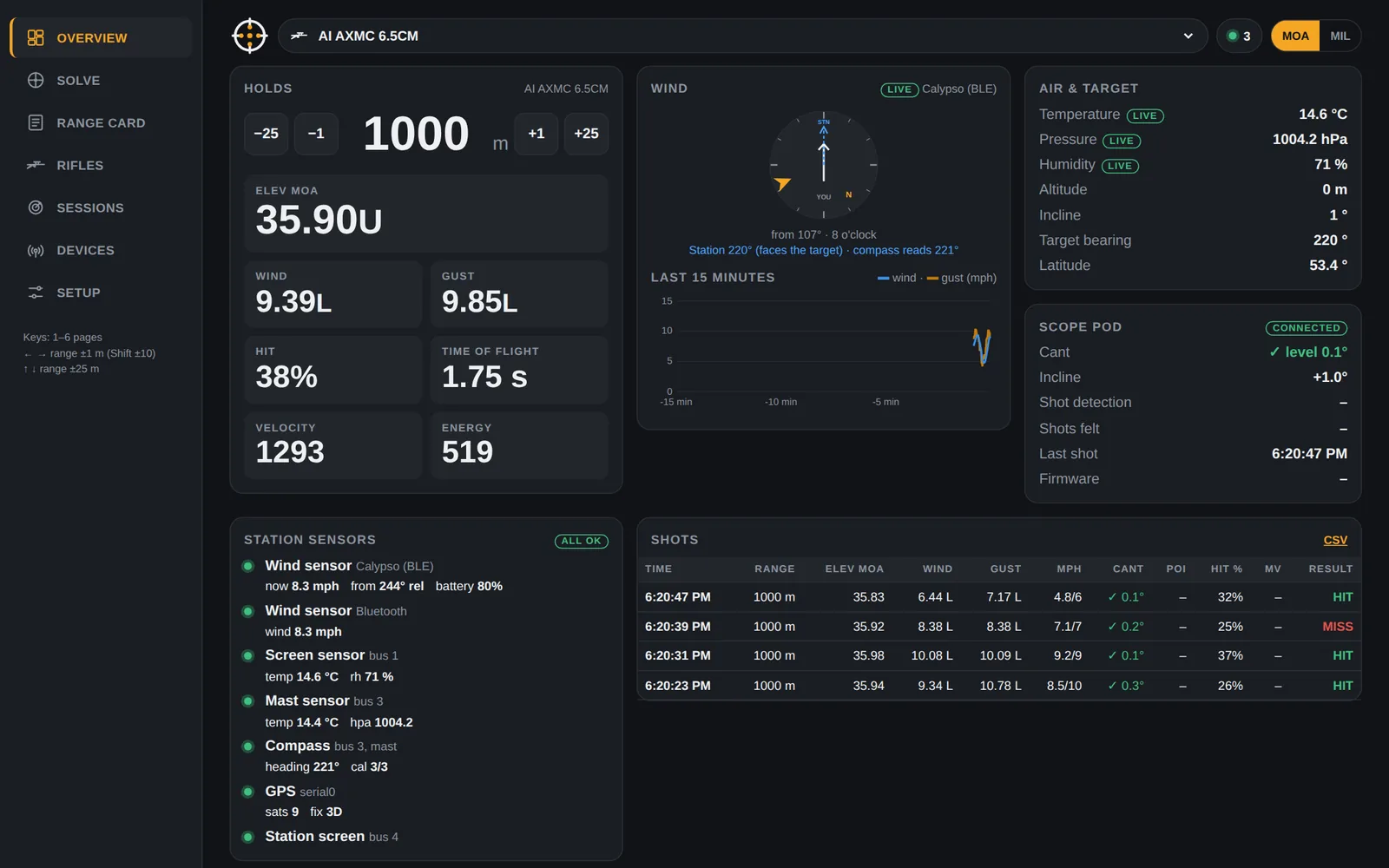
OpenBallistics is a ballistic solver and a set of range hardware that work together. A small station at the bench measures the wind and the air, solves every shot, and sends your hold to your phone and to a pod on your scope, live.
The station sits by the bench on a tripod. It runs its own Wi-Fi hotspot, so there's nothing to set up at the range and no phone signal needed.
Wind from an ultrasonic meter, temperature, pressure and humidity from two sensors, GPS position and a compass for the target bearing.
Every reading goes straight into the solver. Holds update as the wind changes, with gusts, hit probability and time of flight.
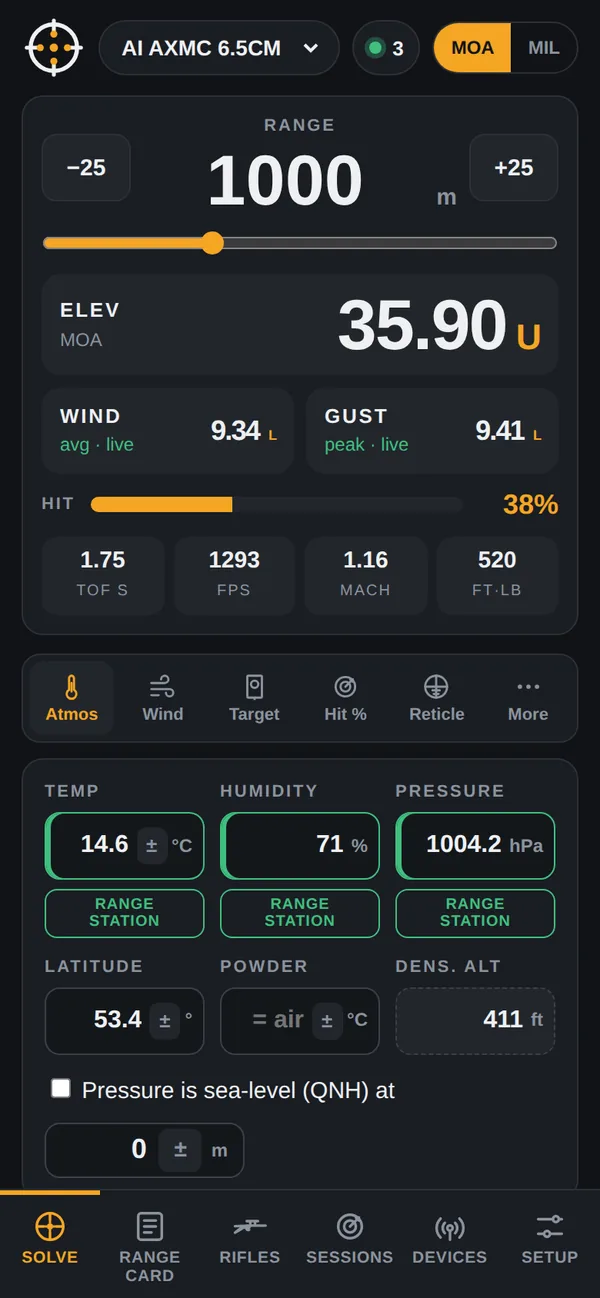
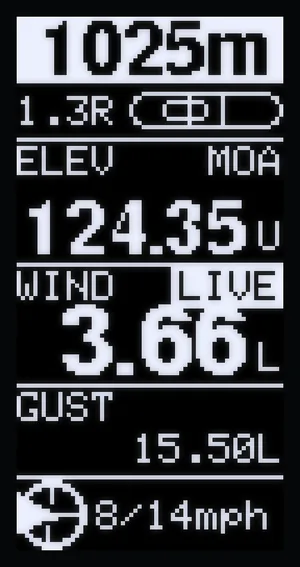
Your phone opens the app from the station. The scope pod shows the hold and your cant while you stay behind the rifle.
Everything here is designed and tested on a real range in the UK, on real rifles.
Wind speed and direction relative to your target, with a 15-minute history, average and gust. Air density from live temperature, pressure and humidity.
G1 and G7 drag, spin drift, Coriolis, incline, powder temperature and truing from your own impacts. Holds in MOA or MIL, with hit probability for your target size.
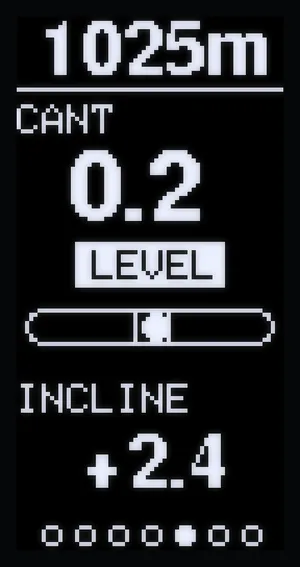
A small screen on your scope rail with the range, hold, wind and a cant bubble. Five LEDs show level at a glance, and it feels the recoil to log each shot.
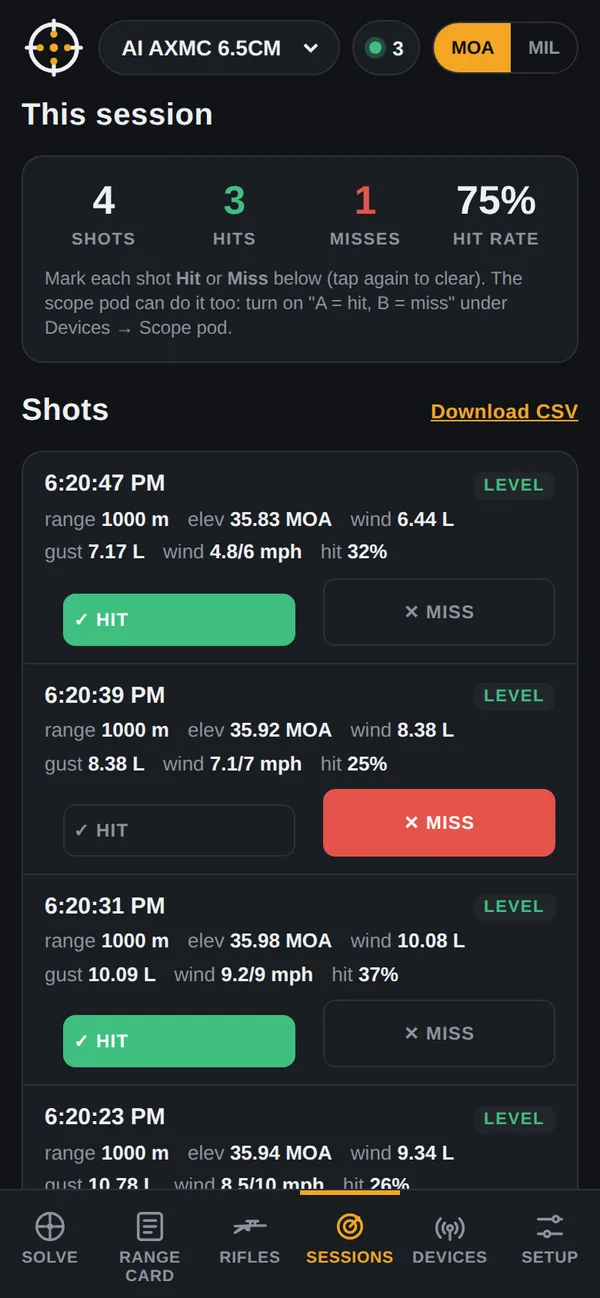
Every shot is logged with its conditions. Mark hits and misses from the phone or with the pod's buttons, and see your hit rate per session.
Connect a GoPro and it records and tags each shot. The desktop app matches the shots to the sound of the video and adds the range, hold and wind as an overlay.
Any sensor can feed the station with a simple JSON message over Wi-Fi. A built-in Bluetooth explorer helps you work out new devices such as rangefinders.
Join the station's Wi-Fi and open it in your browser. Nothing to install, and it works with no signal.
For Windows and macOS. It gives you the full overview at the range, and does the setup and analysis at home.


An ESP32 board, a small screen and two buttons, in a 3D-printed case on your scope rail.
The solver is validated against a leading commercial ballistic solver for a known 6.5 Creedmoor load, with the same inputs, from 100 to 1800 m.
Largest difference anywhere in that range. Drag data is the public G1/G7 standard plus manufacturer-published BCs.
Common, hand-solderable boards from The Pi Hut, Amazon UK and RS. The cases are parametric OpenSCAD designs, made for PETG or ASA on a multi-colour printer.
| Raspberry Pi 3B or newer | Runs the solver, the app and its own Wi-Fi hotspot |
| Ultrasonic wind meter (BLE) | Wind speed and direction, no moving parts |
| 2 × AHT20 + BMP280 | Temperature, humidity and pressure, in a louvred screen and up the mast |
| BNO055 compass | Bearing to the target |
| GT-U7 GPS | Latitude for Coriolis, and the clock |
| 0.96" SSD1306 OLED | Status pages on the case |
| Seeed XIAO ESP32-S3 | Tiny board with Wi-Fi and USB-C |
| 1.3" SH1106 OLED | Or the Sharp 1.8" memory LCD with a small adapter board |
| LSM6DS3 or LIS3DH | Cant and recoil, found by itself at start-up |
| 2 buttons, 5 LEDs | Range and marks; the level bar |
| Small LiPo cell | Charges over USB-C |
Wiring diagrams, pin tables and print files are included with the project.
Download the desktop app for Windows or macOS.
Put an SD card in your computer. The app writes it, then installs and configures the station over Wi-Fi.
Plug the pod in over USB, pick your screen and options, and the app flashes and sets it up.
Join the station's Wi-Fi on your phone, pick your rifle, and your holds follow the wind.
Free. Includes station setup, pod flashing, session analysis and video overlays. The phone app comes from your station, so there's nothing to install on your phone.
No. The station makes its own Wi-Fi network. Your phone joins it and opens the app straight from the station. At home it can join your normal Wi-Fi instead, to get updates.
Yes. The solver runs on any computer with Python, and you can enter the wind and weather by hand. The station is what makes it live.
818 bullets from Barnes, Berger, Hornady, Lapua, Nosler, Sierra and others, using only the ballistic coefficients the manufacturers publish. You can add your own, and true the solver to your actual drops.
An ultrasonic Bluetooth wind meter and a GoPro are supported now, and chronograph support is on the way. Anything else can send readings with the open JSON device protocol, and the Bluetooth explorer helps work out new devices.
No. The desktop app writes the station's SD card, installs the software and flashes the pod for you. You'll need to solder a few boards and print the cases.
Yes, the software is free. You buy the parts yourself.